Immigration news update for all regions
Americas
Chile: Introduction of fast-track business visa for Indian nationals
Chile has announced the implementation of a new expedited business visa aimed for Indian nationals seeking to invest or conduct business activities in the country.
The visa is valid for up to two years and allows multiple entries, with stays of up to 90 days per visit. Authorities have indicated that processing will be more efficient, with reduced response times and fewer administrative steps.
The measure is intended to facilitate the entry of business travelers, including entrepreneurs, professionals, and technical staff, and to strengthen trade and investment ties between Chile and India.
The announcement forms part of broader efforts to deepen bilateral economic relations, including ongoing discussions on a Comprehensive Economic Partnership Agreement (CEPA) and initiatives to expand trade and attract further foreign investment.
This summary was prepared using information provided from the Ministry of Foreign Policy
Asia-Pacific
Malaysia: Update on revised expatriate salary policy
The Expatriate Services Division of the Immigration Department of Malaysia has announced that it will delay the implementation of the upcoming new succession plan requirement until January 1, 2027.
It was announced on January 15, 2026, that the Revised Expatriate Pass Salary Policy will take effect from June 1, 2026. One of the key elements introduced under the new policy is the succession plan requirement, which aims to ensure the structured transfer of knowledge and expertise to local employees throughout the expatriate’s employment period. As part of a phased implementation approach, the succession plan requirement will only take effect from January 1, 2027, allowing employers sufficient time to prepare and align with the new requirement.
This summary was prepared using information provided from the Expatriate Services Division
Thailand: Revision of visa exemption and visa on arrival schemes
On May 19, 2026, the Thailand Government announced approval of the revision of Thailand’s visa exemption and Visa on Arrival schemes. Thes revised measures include:
- The granting only one visa exemption scheme per country/territory;
- Cancellation of the 60-day visa exemption scheme for all 93 countries/territories;
- A Revision of the 30-day visa exemption scheme for tourism purposes and reduction in the list of eligible countries/territories (from 57) to 54 countries/territories;
- The introduction of a new 15-day visa exemption scheme for tourism purpose for 3 countries/territories; and
- A revision of the Visa on arrival (VoA) regulations and reduction in the list of eligible countries/territories (from 31) to 4 countries/territories.
Details and criteria can be found in relevant Ministry of Interior announcements, which will be published in the Royal Gazette and will take effect 15 days after publication.
Foreigners who are already in Thailand under the current visa exemption schemes and those plan to travel to Thailand prior to the effective date of this revision may stay until the expiry of their permitted period of stay.
Thereafter, they may enter Thailand under:
- the new visa schemes;
- bilateral visa exemption agreements; or
- an appropriate visa which can be conveniently applied through Thailand’s e-Visa system.
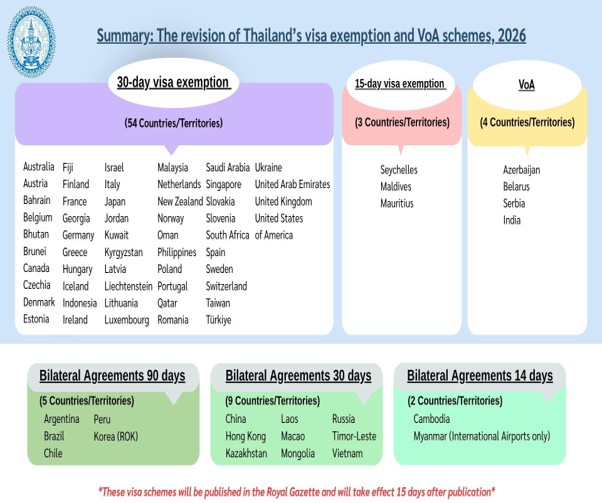
This summary was prepared using information provided from the Department of Consular Affairs
Disclaimer: The above information is provided for general information purposes only and should not be construed as legal advice. If you have any further inquiries regarding the applicability of this information, please contact Debra Beynon (Director of Immigration Services, APAC).
Europe, Middle East and Africa
European Union: New Schengen visa measures for Thai nationals
The European Union has introduced more favorable Schengen visa rules for Thai nationals residing in Thailand, under a new “visa cascade” system.
Under the updated framework, eligible travelers with a positive travel history, specifically those who have previously obtained and lawfully used a Schengen visa within the past two years, may now be granted multiple-entry visas with longer validity.
Initial visas may be issued with a validity of one year, with the possibility to obtain two-year and eventually five-year multiple-entry visas for frequent travelers.
The measure applies to short-stay Schengen visa applicants (allowing stays of up to 90 days in any 180-day period) and is intended to facilitate travel across the Schengen area for bona fide travelers.
This summary was prepared using information provided from the European Union
Ireland: Updates on employment permits system
The government of Ireland has announced a series of updates of its employment permits system, introducing targeted measures to address ongoing skills and labour shortages across key sectors, including construction, healthcare, transport, and agri-food.
Following a comprehensive review launched in summer 2025, the government has confirmed 32 updates to the occupations eligible for employment permits. These changes are designed to better align the permit system with current labour market needs and address persistent shortages across the economy.
The updates include:
- 6 roles added to Critical Skills Employment Permits (CSEP)
- 9 roles added to General Employment Permits (GEP) without quotas
- 2 roles added to GEPs with new quotas
- 15 roles retaining existing GEP quotas
These adjustments reflect feedback from industry stakeholders and labour market analysis, ensuring that the employment permit framework remains responsive and fit for purpose.
The reforms specifically target sectors experiencing acute labour shortages:
- Construction: Ongoing infrastructure and housing demands across the EU have intensified the need for skilled workers.
- Healthcare: Staffing gaps in health and social care continue to challenge service delivery and patient care continuity.
- Transport: Logistics and supply chain pressures have highlighted shortages in critical transport roles.
- Agri-food: Seasonal and specialized labour demands persist in agriculture and food production.
The Government will also begin work on amending the Employment Permits Act 2024, specifically the “50:50 rule,” which requires at least half of a workforce to be UK/EEA nationals.
This summary was prepared using information provided from The Ministry for Enterprise, Tourism and Employment
Sweden: Government proposes measures to prevent separation of young adult dependents
The Swedish government has put forward a proposal aimed at reducing the risk of family separation when children reach adulthood, a situation often described in public debate as “teen deportations.”
The initiative introduces several potential changes to the current framework:
- Extended eligibility for dependents: The age threshold for children included in family applications could increase from 18 to 21.
- Opportunity to reapply within Sweden: Individuals whose applications were denied on or after January 1, 2025, may, in certain cases, be permitted to submit a new application without leaving the country.
- Potential return pathway: Some young adults aged 18-21 who previously departed Sweden following a rejection may be eligible to return under the revised rules.
- Ongoing assessment of related policies: Authorities are also reviewing whether additional flexibility may be introduced, particularly in connection with existing “track change” provisions.
If approved, the changes are anticipated to come into force on October 1, 2026.
For employers and international families, these developments underline Sweden’s ongoing adjustments to its migration system, with potential implications for dependent status and long-term assignment planning.
This summary was prepared using information provided from The Government of Sweden
Health insurance requirement introduced for short-term work permit applicants
Effective June 1, 2026, Swedish authorities have implemented a new requirement mandating comprehensive health insurance for individuals applying for a work permit with an intended stay of one year or less.
Under the new rules, applicants must demonstrate access to insurance coverage that includes:
• Emergency medical treatment
• General healthcare services
• Hospital care
• Dental treatment
• Repatriation on medical grounds, where applicable
This requirement is particularly relevant for employees on probationary contracts or short-term assignments, as evidence of adequate coverage must now be submitted as part of the work permit application.
In addition, employer-provided insurance schemes may be accepted, provided that the documentation explicitly confirms that the individual is covered.
This update is likely to impact recruitment timelines, assignment planning, and compliance processes for employers engaging international talent in Sweden.
This summary was prepared using information shared by Crown’s service partner.
Disclaimer: The above information is provided for general information purposes only and should not be construed as legal advice. If you have any further inquiries regarding the applicability of this information, please contact Joanna Sogeke (European Client Services Manager – Immigration).
We track policy changes in over 120 countries. Find out how we can help you in this short video.